

This article contains affiliate links. If you purchase through one of our links, we may earn a commission at no extra cost to you. This does not influence which products we include or how they are ranked.
For comfortable reading, aim for 300 to 500 lumens for a desk or bedside lamp, and 450 to 750 lumens if you read fine print, craft, or work in a dim room. This range gives you clear text without harsh glare, and a dimmable lamp lets you fine tune it for day and night use.
In this guide you will learn how to match lumens to your age, paper color, and room lighting, how distance and beam angle change perceived brightness, and how to use dimming and color temperature to reduce eye fatigue. For more ideas on placement and style, explore our Lighting inspiration to pair function with your decor.
How to Choose the Right Lumens Step by Step
1. Start With the 350 to 500 Lumen Baseline
For most adults reading a paperback or magazine at 15 to 24 inches, 350 to 500 lumens feels bright enough without washing out the page. It lights the text evenly and keeps contrast comfortable for longer sessions.
If your lamp sits farther away, like a floor lamp beside a sofa, you will need the higher end of that range or a focused beam. A closer desk lamp can stay near the lower end and still feel crisp.
2. Adjust for Your Eyes, Paper Type, and Ambient Light
Age, vision sensitivity, and paper finish change what feels right. Matte cream paper needs less light than glossy white, and older eyes often prefer 500 to 750 lumens for the same task.
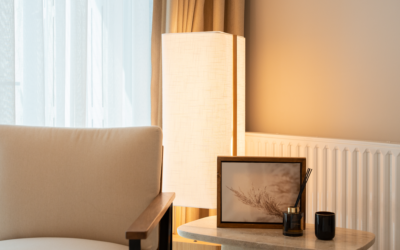
Also consider the room. In a bright living room with overhead lights, you can use fewer lumens on your task lamp. In a dark bedroom at night, a lower, warmer setting prevents glare and helps you wind down, which is why many readers love a floor lamp for reading with stepless dimming.
3. Factor In Distance and Beam Spread
Lumens measure total light output, but lux on the page matters more. Doubling the distance can cut illumination to a quarter, so an adjustable arm that brings light closer is often more effective than simply adding lumens.
A wide, diffused head spreads light across two pages and reduces harsh shadows. A narrow, focused beam concentrates lumens on a small area, useful for crafts or puzzles but too intense for casual novel reading.
4. Pick Dimmable Control and the Right Color Temperature
Choose a lamp with smooth dimming from about 10 percent to 100 percent and a color range of 3000K to 4500K for reading. Warm white around 3000K feels cozy at night, while neutral 4000K to 4500K improves contrast for daytime study.
Look for memory and flicker free drivers, plus touch or remote control so you can adjust without moving. If space is tight, a table lamp for small nightstands with a compact base can still deliver 400 plus lumens right where you need it.
5. Do a Quick Page Check to Lock In Your Setting
Set the lamp at your normal reading distance, open a book, and dim up until the text looks crisp without a halo around letters. If white margins glow or you squint, dial back 10 to 15 percent until the page feels calm.
Save that level with the memory function if your lamp has one, then note the time of day. You will likely want a slightly lower, warmer setting at night and a brighter, cooler setting for daytime focus.
Products That Help You Dial In the Right Brightness
Quick Picks at a Glance

Prime Lepro LED Desk Lamp: 750 lm, 5 Color Modes

Prime Wio-Mio LED Floor Lamp with Adjustable Color

Kitloo DS808 Desk Lamp: 1000LM Dimmable LED Light
As an Amazon Associate we earn from qualifying purchases. Product prices and availability are accurate as of the date/time indicated.
Pros
- 25 lighting combinations for versatile use
- Touch control with memory function
- Flexible adjustable arm and light bar
- Flicker-free diffused lighting for eye comfort
- Sleek minimalist design with small footprint
Cons
- Corded power limits placement flexibility
- No USB charging port on this model
- Plastic components mixed with aluminum build
Pros
- Stepless dimming and color temperature control
- Magnetic remote with 49.2-foot range
- 360-degree adjustable gooseneck
- Quick tool-free assembly in about 2 minutes
- Memory function restores last settings
Cons
- Gooseneck feels somewhat rigid
- Build materials feel lightweight and mostly plastic
- Less height than some users expected
Pros
- 1000 lumens covers wide desk area
- CRI above 95 for color accuracy
- Stable heavy base resists tipping
- Flexible head and base adjustments
- Memory and timer functions included
Cons
- Must be plugged in, no battery option
- Corded power limits placement flexibility
- ABS plastic construction feels less premium
These picks make it easier to hit your ideal lumen level without guessing. Each offers dimmable brightness and adjustable color temperature, plus flexible heads or goosenecks to control distance and spread for comfortable reading.
When This Won’t Fix It
If you still get headaches, blurred text, or eye strain after adjusting lumens, distance, and color temperature, the issue may be uncorrected vision, untreated dry eye, or poor room glare control rather than lamp brightness. Try reducing screen glare and adding soft ambient light, and consult an eye care professional for a vision check.
Frequently Asked Questions
How many lumens do I need for reading in bed at night in 2026?
For bedtime reading, 200 to 400 lumens on a warm 2700K to 3000K setting is usually enough. Keep the lamp close and dimmed, and use a low ambient glow in the room to avoid a sharp contrast between the bright page and dark surroundings.
Is 1000 lumens too bright for a reading lamp?
1000 lumens can be perfect if it is dimmable, because you can run it at 40 to 60 percent for daily reading and boost it for detailed tasks. Without dimming, 1000 lumens at close range often feels harsh and creates glare on white paper.
What lumens are best if I need extra clarity for small print?
For small print, sewing patterns, or puzzles, 500 to 750 lumens with a focused, adjustable head and neutral white around 4000K improves edge definition. Pair the task lamp with gentle ambient light from your Lighting setup to keep contrast balanced and reduce fatigue.



Write Your Review
No reviews yet. Be the first to share your experience!